
As a sports massage and injury rehabilitation specialist, I spend my days working with people at every stage of their movement journey.
During my time treating clients and working on gym floors, I kept seeing the same pattern: dedicated, hard-working women getting sidelined by preventable injuries, tweaked lower backs, aching knees, and nagging shoulder impingements.
When people get injured, their immediate reaction is often to rest completely or ditch weights altogether. But the most effective tool I use to bridge the gap between pain and performance isn’t a massive piece of gym machinery.
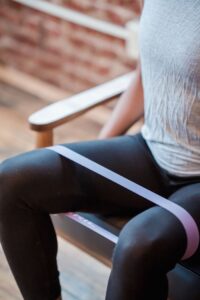
It’s the humble resistance band.
Whether you are recovering from a flare-up or trying to future-proof your body, resistance bands are one of the most science-backed, accessible tools you can use at home.
The Science: Why Resistance Bands Work Magic for Women
Heavy free weights are great, but they subject your joints to peak gravitational force at specific angles. Resistance bands work differently through a principle known as variable elastic resistance.
Here is why that matters specifically for female physiology and joint care:
1. Matching Your Natural Force Curve
Unlike dumbbells, where a weight feels heaviest at the bottom of a movement, a band increases tension as it stretches. This means maximum tension occurs when your muscle is fully contracted and in its strongest position, reducing harsh shear force on your connective tissue at the vulnerable start of a movement.
2. Targeting Stabiliser Muscles
Women naturally have a wider pelvis (Q-angle), which subtly alters biomechanics at the hips and knees. This design makes activating smaller stabiliser muscles, like the gluteus medius and rotator cuff, critical to prevent knees from caving inward (valgus) during daily activities or heavy lifts. Bands force these stabilising muscles to fire constantly throughout the entire movement.
3. Safer During Hormonal Fluctuations
Fluctuations in estrogen throughout the menstrual cycle can temporarily increase ligament laxity (looseness in joint connective tissue). Training with elastic resistance provides dynamic joint stabilisation without overloading vulnerable ligaments with high axial loads.
At-Home Exercises for Strong, Bulletproof Joints
You don’t need a full gym setup to protect your joints. Perform this simple circuit 3 times a week using a light-to-medium mini loop band or long resistance band.
1. Banded Glute Bridges (Hips & Knees)
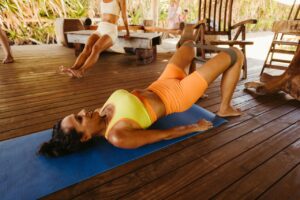
Why it works: Weak glutes force the lower back and knees to take on unnecessary stress. This exercise activates the posterior chain while training the knees to stay aligned.
How to do it: Place a mini loop band just above your knees. Lie on your back with feet flat on the floor, hip-width apart. Drive through your heels to lift your hips, pressing outward against the band. Hold for 2 seconds at the top before lowering slowly.
Repetition: 3 sets of 15 reps.
2. Standing Band Pull-Aparts (Shoulders & Upper Back)
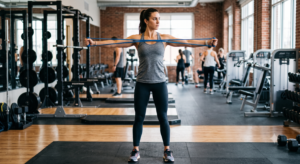
Why it works: Counteracts “desk posture” by strengthening the rear deltoids and rhomboids, stabilising the scapula to prevent shoulder impingement.
How to do it: Hold a flat resistance band in front of you at shoulder height, hands shoulder-width apart. Keeping your arms straight with a subtle bend in the elbows, pull the band apart by squeezing your shoulder blades together until the band touches your chest. Slowly return to the start.
Repetition: 3 sets of 12–15 reps.
3. Banded Clamshells (Hip Stability & ACL Protection)
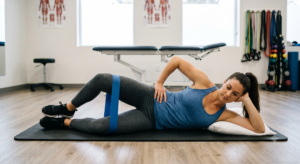
Why it works: Directly targets the gluteus medius, which acts as the main lateral stabiliser for your hip and knee joints.
How to do it: Lie on your side with knees bent at 90 degrees and a mini band wrapped around your thighs above the knees. Keep your feet stacked together and open your top knee as high as possible without rotating your pelvis backwards. Lower controlled.
Repetition: 3 sets of 12 reps per side.
4. Terminal Knee Extensions / TKEs (Knee Rehab)
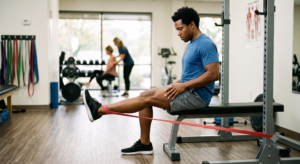
Why it works: Strengthens the vastus medialis oblique (VMO), the teardrop muscle on the inside of your knee, which is vital for knee tracking and patellar health.
How to do it: Anchor a band around a sturdy object at knee height and loop the other end behind your knee joint. Step back until there is tension. Start with a slightly bent knee, then straighten your leg against the band by contracting your quad. Hold for a moment, then release under control.
Repetition: 3 sets of 15 reps per leg.
Rehab Tip: Consistency beats intensity every time. You don’t need to push to absolute muscle failure with band work; focus on slow, controlled tempos and feeling the exact muscle group engage.
Got questions about an injury you’re currently working through? Drop a comment below or book a consultation through [email protected]