
If you’ve hit your 40s and noticed that your usual 5km run or high-intensity cardio class is suddenly leaving you exhausted rather than energised, you aren’t alone.
As we enter perimenopause, our hormones, specifically estrogen and progesterone, start their unpredictable decline. This shift affects everything from our sleep and mood to how our bodies store fat and maintain bone density.
The “more is more” approach to cardio often backfires during this phase by spiking cortisol (our stress hormone).
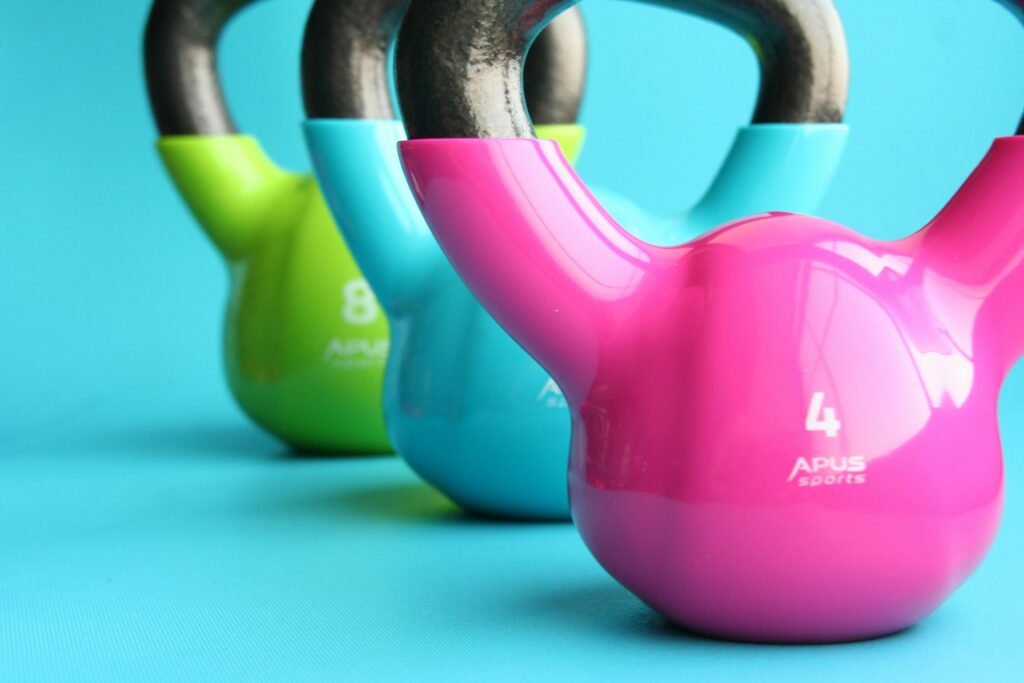
The solution? Heavy, functional, and efficient strength training. Enter: The Kettlebell.
1. It’s a “Bone Density” Powerhouse
Oestrogen protects our bones. As it drops, our risk of osteoporosis climbs. Kettlebell training provides the “mechanical loading” (stress on the bone) required to stimulate new bone growth. A 2017 study showed that High-Intensity resistance and impact training improved bone mineral density and physical function in postmenopausal women with osteoporosis. Unlike static machines, the offset weight of a kettlebell forces your bones and joints to adapt to multi-directional force.
2. Metabolic Fire (Without the Cortisol Spike)
Perimenopause often brings weight gain around the midsection. Muscle is metabolically active tissue; the more you have, the more energy you burn at rest. Kettlebell movements like the Swing or Goblet Squat are compound exercises, meaning they use multiple muscle groups at once, giving you a metabolic boost without the 45 minutes of joint-pounding cardio.
3. Core & Pelvic Floor Integration
Many women experience pelvic floor changes during this transition. Kettlebell training is unique because the off-centre gravity of the bell requires constant core stabilisation. When done with proper core breath (exhaling on the effort), it strengthens the deep abdominals and pelvic floor in a functional way that translates to real-life movements.
The Kettlebell Workout

Perform this 2–3 times a week. Focus on the quality of movement over speed.
The Warm-Up (5 Mins):
Haloes: 10 reps each way (Great for shoulder mobility).
Bodyweight Squats: 15 reps.
Cat-Cow: 1 minute.
The Circuit: (Click the Exercise name for a YouTube demonstration)
| Exercise | Duration | Why it works for Perimenopause |
| Two-Handed Swings | 1 Minute | The foundation for power. Drives heart rate up safely. |
| Goblet Squats | 1 Minute | Essential for hip mobility and lower body bone density. |
| Two-Handed Swings | 1 Minute | Reinforcing the hinge. |
| One-Handed Cleans | 1 Min per side | Teaches unilateral core stability. |
| Clean & Press | 1 Min per side | Vertical loading is the #1 way to protect shoulder/spine density. |
| One-Handed Snatch | 1 Min per side | Massive metabolic demand and explosive power. |
| One-Handed Swings | 1 Min per side | Forces the anti-rotational core muscles (Obliques) to fire. |
| Windmills | 10 Reps per side | Exceptional for mid-section strength and shoulder stability. |
| Turkish Get-Ups | 5 Reps per side | The ultimate full-body move. Improves proprioception (balance), which is vital as we age. |
The Cool Down:
Child’s Pose: 1 minute.
Pigeon Stretch: 1 minute per side (To release tight hips).
In perimenopause, your body is asking for a different kind of care. It’s not about shrinking; it’s about becoming stronger and more resilient. The kettlebell isn’t just a weight; it’s a tool to help you navigate this transition with confidence.