
You have 30 minutes to do a workout between your work schedule, kids and trying to fit in a social life. What can you do to maximise your time and ensure your body gets what it needs?
As women get older, we have a few extra things to think about and combat:
- Sarcopenia (A loss of muscle mass, strength, and function in older adults due to decreasing estrogen)
- Loss of bone mineral content resulting in a higher risk of developing osteoporosis
What Does The Science Say About Women’s Exercise?
The good news is that resistance training (weight, band and bodyweight training) can help us. As always, I will share the scientific study links to help back this up.
- High-intensity strength exercises, whether done alone or with aerobic activity, improved muscle mass, strength, and physical performance. People who exercised more than twice a week also saw a noticeable increase in lean body mass.
Weight-bearing exercise helped increase bone strength in older, postmenopausal women, and those gains stayed as long as they kept exercising. When they stopped, their bone strength went back to previous levels.
- Resistance training helped reduce depression symptoms in adults, no matter their health, how much they exercised, or how much stronger they got.
So let’s look at some great exercises that will build these incredible gains for you!
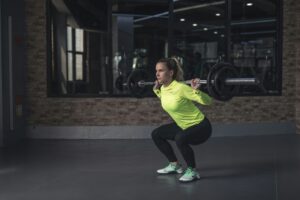
1. Squats (Bodyweight or Weighted)
Why?
- Strengthens legs, hips, and core
- Builds bone density in the spine, hips, and thighs
- Supports balance and functional mobility
How To Do Them (Ideally with weights, dumbbells, kettlebells, resistance band around your feet or a barbell)
- Stand with your feet shoulder-width apart.
- Keep your toes pointing slightly outward (about 10–15 degrees).
- Engage your core.
- Slowly bend your knees and push your hips back as if you’re sitting down into a chair.
- Keep your chest up and your back straight, not rounded.
- Make sure your knees stay in line with your toes ….don’t let them collapse inward.
- Lower down until your thighs are parallel to the floor, or as low as is comfortable for your mobility.
- Push through your heels (not your toes) to stand back up engaging your glutes (butt muscles).
- Straighten your legs and return to the start position.
- Keep your core tight and avoid locking your knees at the top.
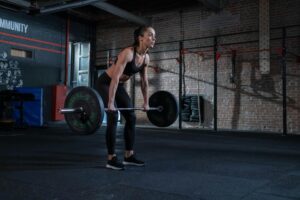
2. Deadlifts
Why?
- Engages major muscle groups (glutes, hamstrings, back, core)
- Excellent for posture and spine health
- Improves lean muscle mass and metabolic rate
How To Do Them (Ideally with a barbell or dumbells)
- Stand with your feet hip-width apart.
- Place the weights (dumbbells or barbell) in front of you, close to your shins.
- Keep your toes pointing forward and your shoulders back.
- Engage your core and keep a neutral spine (no rounding or arching…think stick your butt out and squeeze shoulder blades together).
- Hinge at the hips: Push your hips back then bend your knees slightly to reach down and grip the weights.
- Hands should be just outside your legs if using a barbell, or by your sides if using dumbbells.
- Press through your heels.
- Drive your hips forward and stand up tall, keeping the weights close to your body.
- Your back stays straight, chest lifted, and shoulders drawn back at the top.
- Reverse the movement by hinging at your hips first, then bending your knees.
- Lower the weight slowly and in control, keeping it close to your legs.
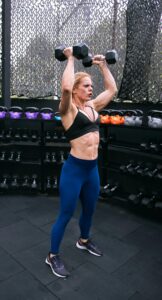
3. Overhead Press (Dumbbells, barbell or resistance bands)
Why:
- Strengthens shoulders, arms, core and upper spine
- Promotes upper body bone density
- Helps with daily activities like lifting and carrying
How To Do Them (ideally with a barbell or dumbells)
- Stand tall with your feet shoulder-width apart.
- Hold a dumbbell in each hand or a barbell, resting them at shoulder height, palms facing forward.
- Engage your core and keep your back straight, avoid arching.
- Keep your elbows slightly in front of your shoulders, not flared straight out to the sides.
- Press the weights upward until your arms are fully extended overhead, but don’t lock your elbows tightly.
- Keep the weights moving in a straight line, close to your ears.
- Pause briefly at the top.
- Lower the weights slowly back to shoulder height, staying in control.
4. Pull Ups (Bodyweight or with a resistance band)
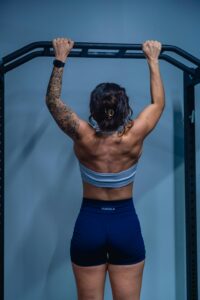
How To Do Them (Bodyweight or buuld up using a resistance band)
- Find a sturdy pull-up bar (at a gym, park, or home setup).
- Grip the bar with your palms facing away from you (overhand grip) for a wide pull-up or towards you for a close-grip pull-up. If you are using a band, hook it over bar and put one foot, or knee, through it.
- Let your body hang fully with your arms extended and feet off the ground.
- Engage your shoulders and core, don’t just dangle loosely.
- Pull your chest toward the bar by driving your elbows down and back.
- Keep your chin above the bar at the top.
- Lower yourself slowly and in control until your arms are straight again.
This one requires lots of practice! Jump up and lower down to begin with to help build strength.
5. Chest Press
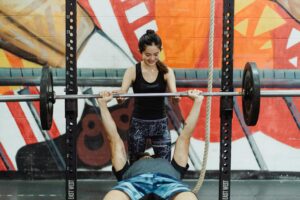
How To Do Them (Ideally with a barbell or dumbells)
- Lie flat on a bench (or on the floor if you don’t have one), with your feet flat on the ground.
- Hold dumbbells in each hand (or grip a barbell) with arms bent and elbows slightly below shoulder level.
- Your palms face forward, and your wrists should stay straight, not bent backwards.
- Engage your core and keep a slight, natural arch in your lower back.
- Push the weights up until your arms are extended above your chest ….not over your face!
- Don’t lock your elbows at the top; keep a soft bend.
- Lower the weights slowly and with control until your elbows are about 90 degrees or just below the bench level.
I also have an article on Push-Ups here if you prefer these.
How Many Reps & Sets?
Start with 4 sets of 8-10 repetitions with a weight heavy enough that the last set is difficult to complete. As you get stronger, aim for 5 sets of 5 repetitions that are quite heavy.
Yes, you can do this in 30-40 mins if you rest for under 30 seconds and use this to keep your heart rate up. The heavier you go, you will want to rest longer and split your exercises into different days so you keep to under 40 mins workouts.
Remember, each workout you are aiming for good form over the number of repetitions you do and each time you will be breaking muscle fibres, feeling sore the next few days and getting stronger.
Don’t give up! You will be doing so much good for your body every time you turn up.